






Heat-Transfer Fluid Viscosity in HVAC Systems: Why It Matters for Flow and Pump Selection
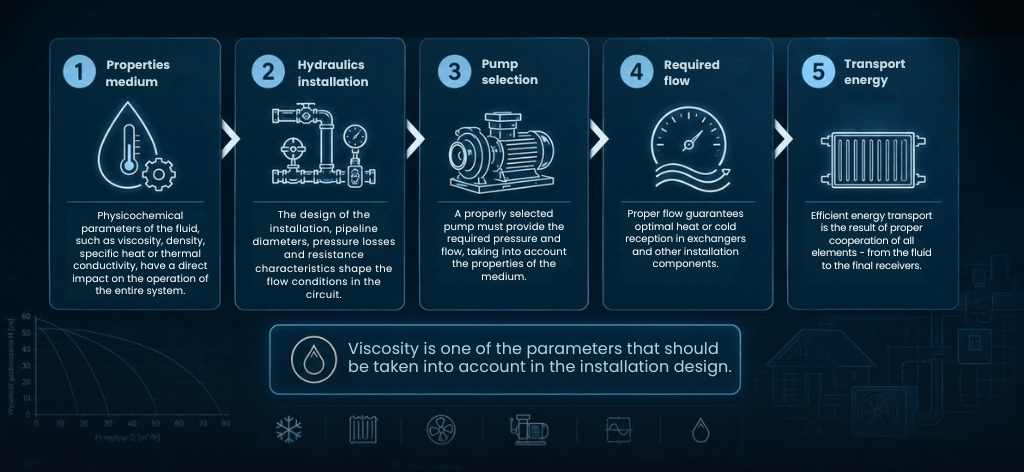
When selecting an antifreeze fluid, the freezing point is usually the first parameter to be considered. It is important, but it does not provide a complete picture of how the fluid will behave during the system’s daily operation.
The fluid circulates through pipes, valves, filters, pumps and heat exchangers. Its properties therefore affect not only protection against freezing, but also the hydraulic characteristics of the system, the ability to achieve the required flow rate and the conditions under which energy is transferred.
One parameter that should be considered when designing and operating a system is heat-transfer fluid viscosity.
However, viscosity alone is not a measure of fluid quality. A fluid with lower viscosity is not necessarily a better solution for every system, just as a fluid with higher viscosity is not an inferior product.
Each chemical base addresses different requirements related to operating temperature, user safety, material compatibility and system design.

What Is Heat-Transfer Fluid Viscosity?
Viscosity describes the resistance a liquid creates as it flows.
Its value affects the hydraulic requirements of the system and should therefore be considered when selecting:
- the pump,
- pipe diameters,
- valves and fittings,
- heat exchangers,
- the required flow rate.
Technical documentation for heat-transfer fluids often specifies kinematic viscosity, expressed in mm²/s. However, this parameter should never be evaluated without considering the temperature at which it was measured.
The same fluid can have a very different viscosity at:
- +20°C,
- 0°C,
- –10°C,
- –20°C.
A fluid that is easy to pump while the system is being filled at room temperature may behave differently once it reaches its actual operating temperature.
For this reason, comparing fluids only on the basis of values measured at +20°C may not provide a reliable indication of their performance during operation.
Why Does Viscosity Change with Temperature?
As temperature decreases, most heat-transfer fluids become more viscous. This change is not always linear.
As a result, the difference between two fluids may be relatively small at room temperature but much more significant at 0°C or –10°C.
An increase in viscosity can affect:
- pressure losses in pipework,
- resistance across valves and filters,
- the pump operating point,
- the actual flow rate,
- hydraulic balancing,
- heat-transfer conditions.
This is not a defect of a particular fluid. It is a physical property that must be considered during system design.
A correctly selected pump and a properly designed system can provide the required flow rate even when operating with a fluid of higher viscosity.
How Does Viscosity Affect the System?
As a fluid circulates, some of its energy is used to overcome resistance within the system.
Pressure losses occur in:
- straight pipe sections,
- elbows and tees,
- valves,
- filters,
- manifolds,
- heat exchangers,
- changes in pipe diameter and flow direction.
Their magnitude depends not only on the type of fluid, but also on pipe length and diameter, flow velocity, fluid density and the overall design of the system.
The relationship can be presented as follows:
The higher the viscosity of a fluid at a given temperature, the more important it becomes to include that value in hydraulic calculations.
This does not mean that a higher-viscosity fluid prevents efficient operation. It simply means that the system must be designed accordingly.
Heat-Transfer Fluid and the Pump Operating Point
A pump does not operate according to one fixed parameter. Its actual operating point results from the relationship between the pump curve and the hydraulic characteristics of the system.
When the fluid changes, the pump’s operating conditions may also change.
A pump selected only on the basis of water parameters may operate differently after the system is filled with a glycol-, glycerine- or potassium-formate-based fluid.
Considering the target fluid at the design stage helps to:
- achieve the required flow rate,
- select the correct pump head,
- operate the pump within an appropriate performance range,
- maintain sufficient reserve for natural changes within the system,
- reduce the risk of commissioning problems.
In an existing system, changing the type of fluid should be preceded by an assessment of the system parameters.
Not every fluid can be introduced into an existing installation without additional technical preparation.
Viscosity and Energy Transfer
The primary function of a heat-transfer fluid is to transport energy between the source and the receiver.
Several parameters affect the efficiency of this process:
- viscosity,
- density,
- thermal conductivity,
- specific heat capacity,
- flow rate,
- temperature difference,
- heat-exchanger design.
Viscosity should therefore not be assessed separately from the fluid’s other properties.
A fluid with favourable viscosity can make it easier to achieve the required flow rate, but it must also meet the system’s requirements for:
- operating temperature,
- safety,
- corrosion protection,
- material compatibility,
- system design.
Only by considering all these factors can the right solution be selected for a specific system.
How do different heat transfer fluids behave as the temperature decreases?
The comparison below presents the kinematic viscosity of selected Procold
heat transfer fluids in ready-to-use variants rated to −20°C.
Source: current Procold technical data. The comparison applies to
ready-to-use product variants rated to −20°C.
The data shows that different chemical bases respond differently as the
temperature decreases. However, the comparison should not be interpreted
as a product ranking or as an indication that one solution is universally
the best.
The products are not interchangeable. They have been developed for
different types of installations and different technical priorities.
How Should the Comparison Be Interpreted?
The table demonstrates why the properties of the target fluid must be considered during system design.
It does not mean that:
- every system should use the fluid with the lowest viscosity,
- SUPERCOOL can replace glycol in any installation,
- glycol-based fluids are less valuable,
- one product can meet every market requirement.
The correct conclusion is:
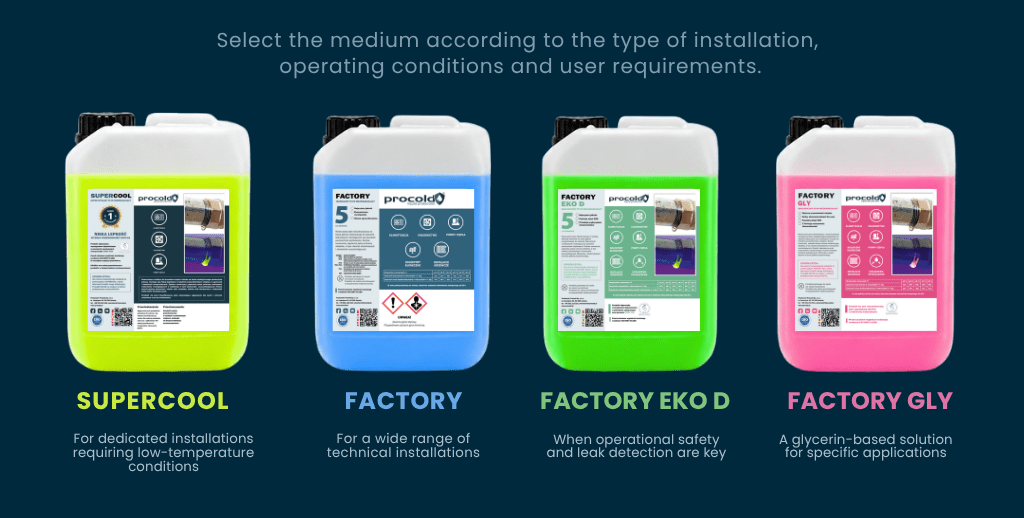
SUPERCOOL — for Dedicated Systems
SUPERCOOL is a potassium-formate-based heat-transfer fluid intended, among other applications, for demanding low-temperature systems. It maintains relatively low viscosity at sub-zero operating temperatures.
However, it is not a universal product or a direct one-to-one replacement for glycol-based fluids.
SUPERCOOL must be used in a system specifically designed for a potassium-formate-based heat-transfer fluid. The system must be designed and prepared with consideration for the fluid’s properties, construction materials, seals and technological requirements.
For this reason, SUPERCOOL’s low viscosity is an advantage in a specific application rather than a general advantage over all other heat-transfer fluids.
It should not be introduced into an existing glycol system without prior technical assessment and appropriate system preparation.
FACTORY — for a Wide Range of Technical Systems
FACTORY is a monoethylene-glycol-based heat-transfer fluid intended for systems where performance and versatile technical application are important and where an environmentally focused product is not required.
Its benefits include suitability for a wide range of appropriately designed technical systems and availability in several temperature versions.
Its higher viscosity compared with a potassium-formate-based fluid does not indicate lower quality. It is one of the physical properties resulting from the chemical base and should be considered when selecting the pump and designing the system.
FACTORY EKO — When User Safety Is a Priority
FACTORY EKO is based on monopropylene glycol. It holds a PZH approval and is intended for systems with a broad range of applications in which user safety is particularly important. A leak-detection version is also available.
In this case, the primary benefit is not achieving the lowest possible viscosity, but combining freeze protection with requirements related to safe system operation.
FACTORY GLY — a Glycerine-Based Solution
FACTORY GLY is a glycerine-based fluid with PZH approval and a leak-detection system. It is intended, among other applications, for systems operating at higher temperatures.
Its application responds to different requirements than a low-temperature potassium-formate-based fluid.
Comparing the two solutions solely on the basis of viscosity would overlook their intended applications and most important benefits.
Does Lower Viscosity Mean Lower Operating Costs?
Lower viscosity can help reduce hydraulic resistance and make it easier to achieve the required flow rate.
However, selecting a lower-viscosity fluid does not automatically reduce energy consumption.
The actual result depends on:
- system design,
- pump efficiency,
- control method,
- operating point,
- pipe lengths and diameters,
- the number of fittings and local resistance points,
- the condition of filters and heat exchangers,
- the required heating or cooling capacity.
If the fluid is not compatible with the system or the installation was not designed for it, the potential benefit of one parameter will not compensate for an incorrect overall selection.
For this reason, compatibility with the design and intended use of the system is more important than simply searching for the lowest viscosity.
Why Does Fluid Concentration Matter?
When concentrates are used, the correct dilution ratio is also important.
A higher concentration may improve freeze protection, but it also changes:
- viscosity,
- density,
- thermal conductivity,
- specific heat capacity,
- pump requirements.
Matching the concentration to the actual minimum operating temperature makes it possible to combine the required level of freeze protection with suitable hydraulic and thermal properties.
The principle of “the more concentrate, the better” does not always provide additional benefits for the system.
When Is Viscosity Analysis Particularly Important?
Viscosity should be carefully considered in:
- systems operating at sub-zero temperatures,
- large industrial circuits,
- systems with long pipe runs,
- systems with limited pipe diameters,
- installations requiring high flow rates,
- ground-source heat-pump circuits,
- systems with limited pump performance reserve,
- modernised installations or systems being filled with a different fluid than before.
The more demanding the operating conditions, the more important it becomes to evaluate not only freeze protection, but the complete set of fluid properties.
Common Mistakes When Assessing a Heat-Transfer Fluid
Selecting a Fluid Only by Its Freezing Point
A similar level of freeze protection does not mean identical viscosity, density, thermal conductivity or intended application.
Treating Fluids as Direct One-to-One Replacements
Changing the chemical base may require different materials, seals, system design and preparation procedures.
This is particularly important when moving from a glycol-based fluid to a potassium-formate-based solution.
Using Calculations Based Only on Water
A pump selected for water may operate differently when an antifreeze heat-transfer fluid is introduced.
Comparing Products Without Considering Their Application
The lowest viscosity is not an advantage if the fluid does not meet the system’s safety requirements or is not compatible with its construction.
Using an Excessively High Concentration
An unnecessarily high concentration may increase hydraulic requirements without providing a justified operational benefit.
The Right Fluid Is the Fluid That Fits the System
There is no single heat-transfer fluid suitable for every installation.
SUPERCOOL can provide significant benefits in dedicated low-temperature systems, but it is not a universal solution.
FACTORY meets the requirements of a wide range of technical systems.
FACTORY EKO supports safe operation where user safety is particularly important.
FACTORY GLY provides a glycerine-based solution for appropriately selected applications, including systems operating at higher temperatures.
Each product serves a different purpose.
The correct selection process is therefore not about identifying the winner of a table. It is about answering the following questions:
- At what temperature will the system operate?
- Which materials are used in its construction?
- What are the safety requirements?
- Which pump and seals are used?
- Is the system designed for the selected fluid type?
- Which parameters are most important for the application?

Need Support Selecting a Heat-Transfer Fluid?
Send us the basic information about your system:
- system type and application,
- minimum and maximum operating temperature,
- system volume,
- required flow rate,
- pump parameters,
- materials and seals,
- currently used fluid.
Based on this information, we can help identify the parameters that should be considered and the type of fluid that matches the conditions of the specific system.
Frequently Asked Questions
Is a Lower-Viscosity Fluid Always Better?
No. Lower viscosity can be beneficial under specific hydraulic conditions, but it does not determine whether a fluid is suitable for a particular system. Compatibility, safety, temperature, thermal properties and system design must also be considered.
Can SUPERCOOL Be Used Instead of Glycol in an Existing System?
SUPERCOOL should not be treated as a direct one-to-one replacement. It requires a system specifically designed for a potassium-formate-based heat-transfer fluid. Any change should be preceded by a technical assessment and appropriate system preparation.
Does Higher Viscosity Mean Lower Product Performance?
No. Viscosity is a physical property that must be considered during system design. Higher-viscosity fluids may provide other important benefits related to safety, intended application or chemical base.
Can a Pump Selected for Water Be Used with Glycol?
It may be possible, but the parameters must be verified. Introducing an antifreeze heat-transfer fluid changes the properties of the circulating medium and therefore affects the hydraulic characteristics of the system.
Why Should Viscosity Be Checked at Several Temperatures?
Because viscosity changes with temperature. Fluids with similar properties at +20°C may behave differently at 0°C or –10°C.
How Should the Right Heat-Transfer Fluid Be Selected?
The selection should consider operating temperature, materials, seals, pump parameters, safety requirements and the intended use of the system. A product should never be selected on the basis of one parameter alone.
Articles

Heavy Duty Coolant for Industrial Engines – What Does It Really Mean?
How does a Heavy Duty coolant differ from a plain glycol base? We explain the role of inhibitors, […]
12/10/2026
How to Choose a Heat Transfer Fluid for an HVAC System? 7 Key Selection Criteria
Discover 7 key criteria: temperature, materials, safety, pump parameters and fluid monitoring.
24/09/2026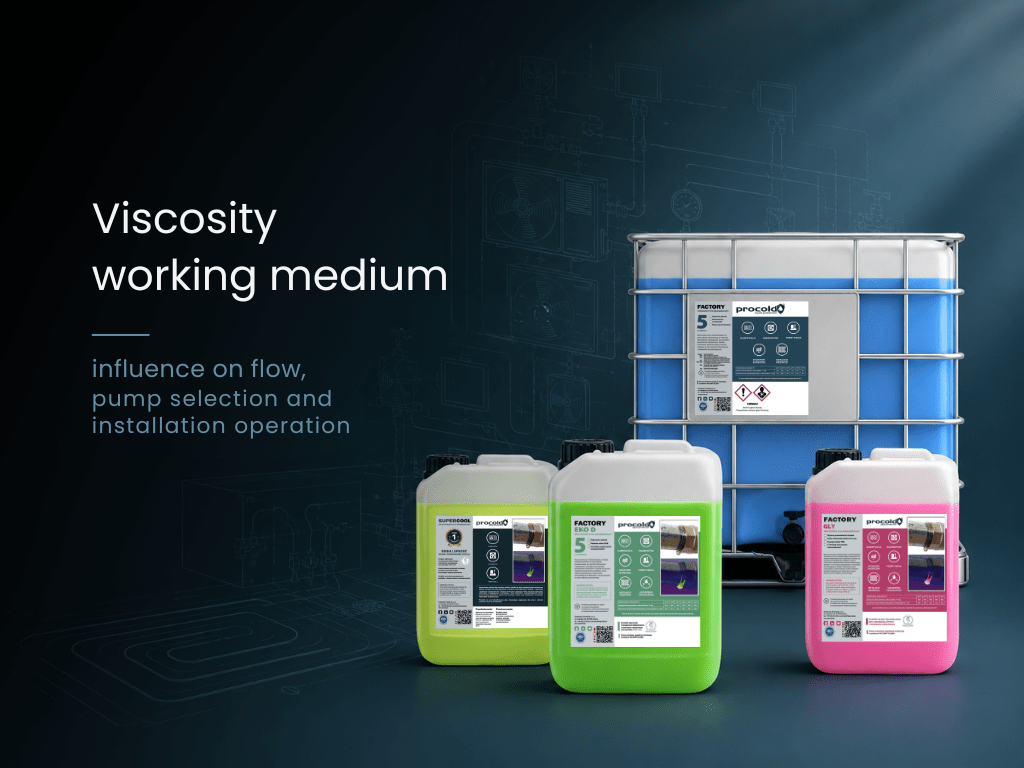
Heat-Transfer Fluid Viscosity in HVAC Systems: Why It Matters for Flow and Pump Selection
Learn how fluid viscosity affects flow, pump selection and HVAC system performance—and why every heat-transfer fluid requires the […]
05/08/2026
How to Detect Leaks in an HVAC System? The Prolight D1018 Detector Lamp in Practice
See how the Prolight D1018 helps you quickly detect leaks in HVAC systems.
02/07/2026
QuickTest Inhibitor – a quick check of the anti-corrosion protection of HVAC installations
See how QuickTest Inhibitor test strips help you quickly verify the level of corrosion protection in HVAC systems […]
01/06/2026
HVAC Optimization: How Aquacorr SI Restores System Efficiency (Case Study)
How can you protect your central heating and HVAC systems from corrosion? Discover an effective solution based on […]
28/04/2026
Water in a Heat Pump System – What Really Determines System Longevity?
HVAC system fluid – a key yet often overlooked factor in system longevity.
30/03/2026
Delivery of Factory ECO to a Large Installation – Behind the Logistics Process
What does the delivery of Factory ECO to a large installation look like? Discover the logistics process, loading […]
13/02/2026