





How to Choose a Heat Transfer Fluid for an HVAC System? 7 Key Selection Criteria
Procold Educational Series: “Heat Transfer Fluid Is Not a Detail” — Part 2
In our previous article, we explained why fluid viscosity affects flow, pump operating point and the hydraulic characteristics of an HVAC system.
However, viscosity is only one part of the selection process.
A heat transfer fluid must transport energy effectively, protect the system against freezing and corrosion, remain compatible with system materials and meet the required safety criteria. The technical condition of the system, the way it is prepared before filling and the possibility of monitoring the fluid later in operation are equally important.
For this reason, the selection process should not begin with a product name or a comparison of a single parameter.
First, understand the operating conditions of the system. Only then can you select a fluid whose properties match those conditions.
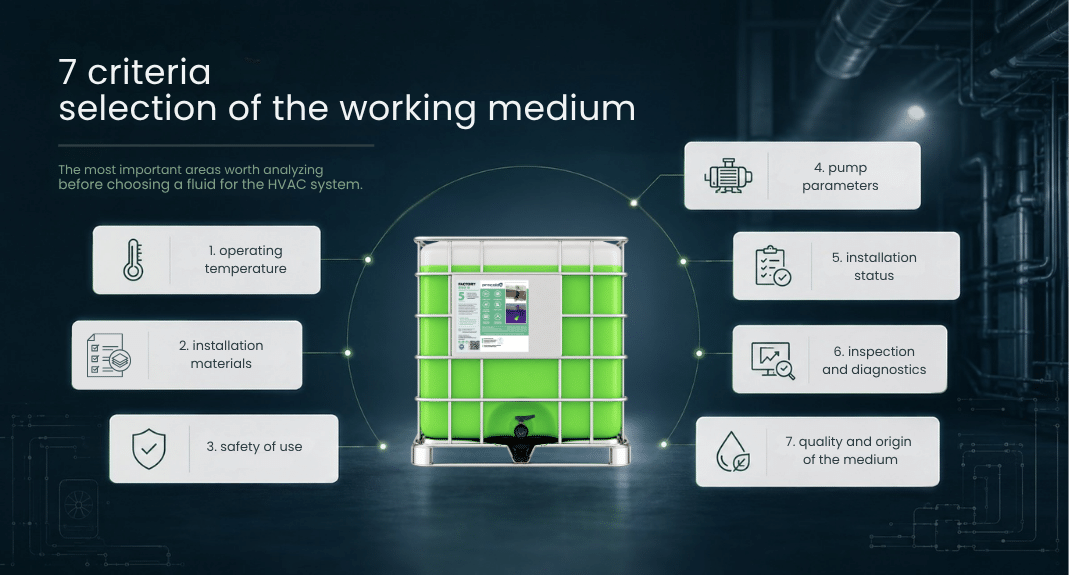
The following seven criteria help structure the entire process.
1. Actual operating temperature range
The first step is to determine the temperatures at which the fluid will actually operate — not only the limit value shown in product documentation.
The analysis should include:
- minimum operating temperature,
- maximum operating temperature,
- conditions during system shutdown,
- the possibility of local pipework cooling,
- emergency temperatures,
- the required freeze-protection margin.
Different systems have different priorities.
Solar thermal and high-temperature systems
In solar thermal systems, the fluid may periodically be exposed to very high temperatures. Freeze protection is therefore only one consideration. Thermal stability, boiling point and the properties of the chemical base are also important.
Depending on system requirements, appropriately selected fluids based on propylene glycol or glycerine may be considered.
FACTORY EKO combines antifreeze protection with the safety characteristics of a propylene glycol base. FACTORY GLY, on the other hand, is based on glycerine and is intended, among other applications, for systems operating at elevated temperatures.
The benefit does not come from the name of the chemical base itself, but from matching its properties to the maximum temperatures, materials and design of the complete system.
Industrial refrigeration
In low-temperature systems, fluid viscosity, pressure losses and the ability to maintain the required flow rate become particularly important.
Depending on the application, solutions based on monoethylene glycol or potassium formate may be used.
FACTORY combines favourable operating parameters with cost efficiency in closed technical and industrial systems.
SUPERCOOL is intended for dedicated systems designed to operate with a potassium formate-based fluid, including installations exposed to very low operating temperatures. Its low viscosity can support hydraulic optimisation when the properties of the fluid are taken into account during system design or modernisation.
However, SUPERCOOL should not be treated as a 1:1 replacement for glycol. Changing the chemical base requires confirmation of compatibility with materials, seals, equipment and the system preparation procedure.
Ground-source heat pump loops
Ground-source heat pump loops usually operate within a narrower temperature range than industrial refrigeration systems. The main requirement is typically protection against sub-zero temperatures combined with stable fluid performance up to approximately +20°C.
Dedicated solutions for this type of application include:
- GEOTHERMAL — based on monoethylene glycol, when operating performance and system economics are the main priorities,
- GEOTHERMAL EKO — based on monopropylene glycol, when user safety is particularly important.
Using a product designed specifically for ground-source heat pump loops makes it easier to match the fluid to typical temperatures and operating conditions of the ground heat exchanger.
Correctly defining the operating temperature range helps avoid both insufficient freeze protection and unnecessary over-concentration.
We discussed the relationship between temperature, viscosity and pump selection in more detail in our previous article: “Heat Transfer Fluid Viscosity in HVAC Systems — Why Does It Matter for Flow and Pump Selection?”
2. Construction materials and corrosion protection
HVAC systems are rarely made from only one material. A single installation may contain:
- steel and cast iron,
- copper and brass,
- aluminium,
- aluminium-silicon alloys,
- plastics,
- seals and elastomers.
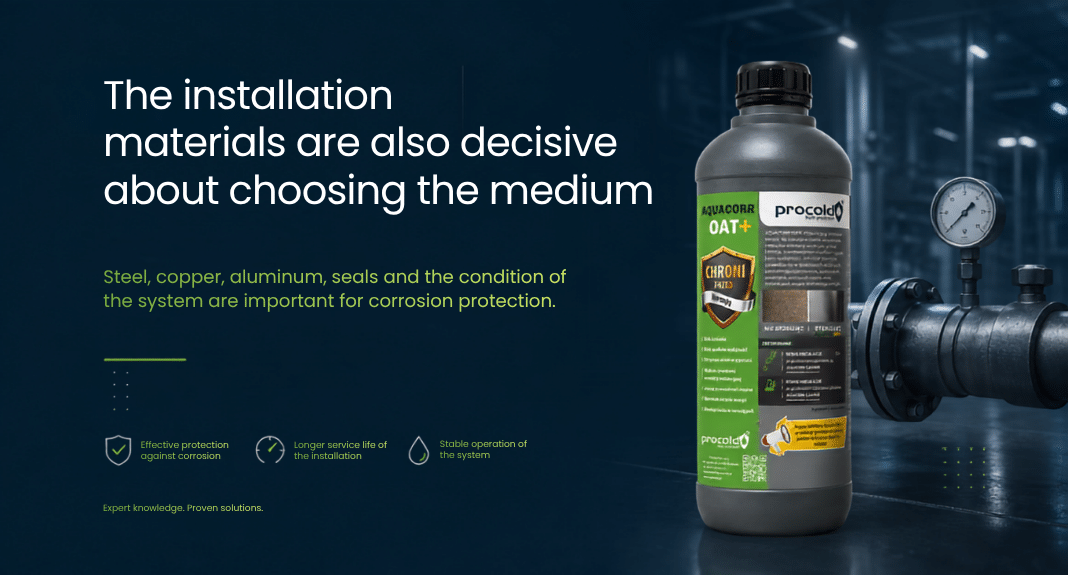
Each of these materials may react differently to fluid chemistry, temperature, oxygen and contamination.
Multi-metal systems require particular attention. Without appropriate protection, corrosion products, deposits and sludge may form inside the system. These can:
- reduce available flow area,
- contaminate filters and heat exchangers,
- make system balancing more difficult,
- accelerate wear of system components,
- reduce heat transfer performance.
System water also needs to be properly prepared. Demineralisation alone does not address every potential issue. Parameters such as pH, electrical conductivity, oxygen content, hardness and the materials used in the system also matter.
Depending on the system design, either a heat transfer fluid with an integrated corrosion protection package or a dedicated corrosion inhibitor may be used.
AQUACORR OAT+
AQUACORR OAT+ uses organic inhibitor technology with the addition of sodium molybdate. It is designed to protect water-based systems against corrosion, deposits and sludge and can be used in systems containing aluminium.
The inhibitor level can later be checked using QUICKTEST strips.
Key benefit: combining corrosion protection for multi-metal systems with straightforward monitoring during routine service.
AQUACORR SI
AQUACORR SI is a silicate-based inhibitor intended for appropriately selected closed systems. It should not be mixed with other fluids and is not intended for installations containing aluminium components.
Key benefit: effective protection of compatible systems at a very low dosing level, provided that material and chemical compatibility requirements are met.
The inhibitor should be selected for the materials, condition of the system and previously used chemistry. There is no single additive suitable for every installation.
3. Safety for people and the environment
The choice of chemical base should take into account not only technical performance but also the possible consequences of a leak.
Before selecting a fluid, determine whether it could come into contact with:
- people,
- domestic water,
- food,
- production surfaces,
- soil,
- the natural environment.
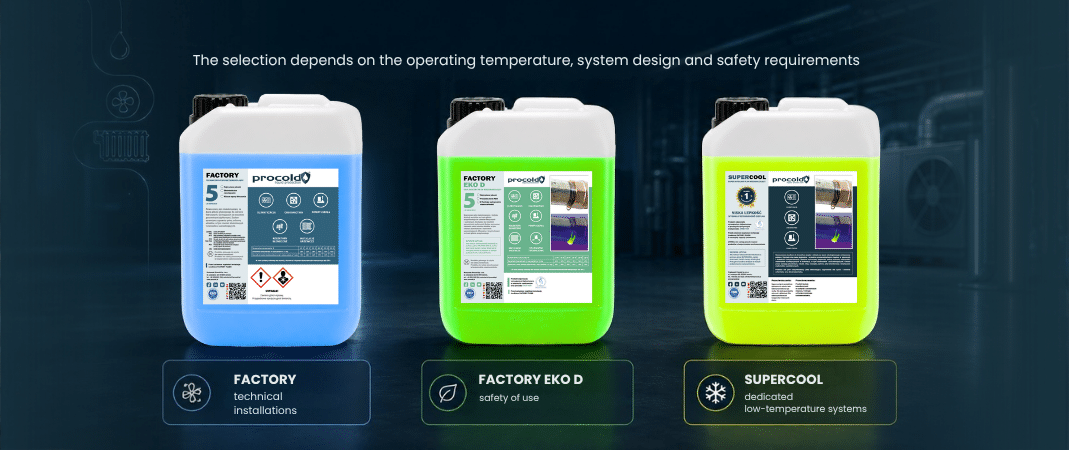
FACTORY EKO — safety and a wide range of applications
FACTORY EKO is based on monopropylene glycol and has PZH approval. It is intended for systems in which user safety is one of the main selection criteria.
It may be considered for residential buildings, public facilities and systems associated with the food industry.
The FACTORY EKO D version additionally enables the use of a leak detection system.
Key benefit: combining freeze and corrosion protection with higher requirements for user and environmental safety.
FACTORY — performance and economics for technical systems
FACTORY is based on monoethylene glycol. It is intended for closed technical and industrial installations where the possibility of contact with people, food, domestic water or the environment has been excluded.
The availability of several temperature variants makes it possible to match the required freeze protection to the actual operating conditions.
Key benefit: a favourable combination of operating performance, versatility and economics in technical installations.
SUPERCOOL — safety in dedicated low-temperature systems
SUPERCOOL is an environmentally friendly potassium formate-based fluid with PZH approval and a leak detection system.
It is intended for installations designed or prepared to operate with this technology.
Key benefit: combining safety with properties suited to demanding low-temperature systems.
FACTORY GLY — glycerine-based solution for selected systems
FACTORY GLY is based on glycerine, has PZH approval and includes a leak detection system. It is intended, among other applications, for systems operating at elevated temperatures.
Key benefit: combining a safety-oriented chemical base with properties suited to selected heating and solar thermal systems.
These fluids do not form a ranking from best to worst. Each is intended to meet a different combination of technical and operational requirements.
4. Pump parameters and system efficiency
The selected fluid should be taken into account when sizing:
- the pump,
- pipe diameters,
- heat exchangers,
- control valves,
- the required flow rate.
Properly matched fluid properties help maintain the design flow rate and provide suitable operating conditions for system components.
Lower-viscosity fluids may help reduce hydraulic resistance and support pump-system optimisation in certain applications. This does not mean that one product will always guarantee the lowest operating cost.
The actual result also depends on:
- operating temperature,
- pipe length and diameter,
- required flow rate,
- pump characteristics,
- control strategy,
- heat exchanger design,
- condition of filters and valves.
In new systems, calculations should be based on the properties of the intended fluid.
In existing systems, any change of fluid type requires verification that the pump, heat exchanger, seals and other components will continue to operate under suitable conditions.
The benefit does not come from choosing a fluid with the best single parameter. It comes from matching the complete set of properties to the specific system.
5. System condition — new or already in operation?
Even a correctly selected fluid may lose its properties prematurely if it is introduced into an inadequately prepared system.
New installation
A new system may still contain:
- process oils,
- metal particles and installation debris,
- residues of sealing compounds,
- dust and manufacturing contaminants.
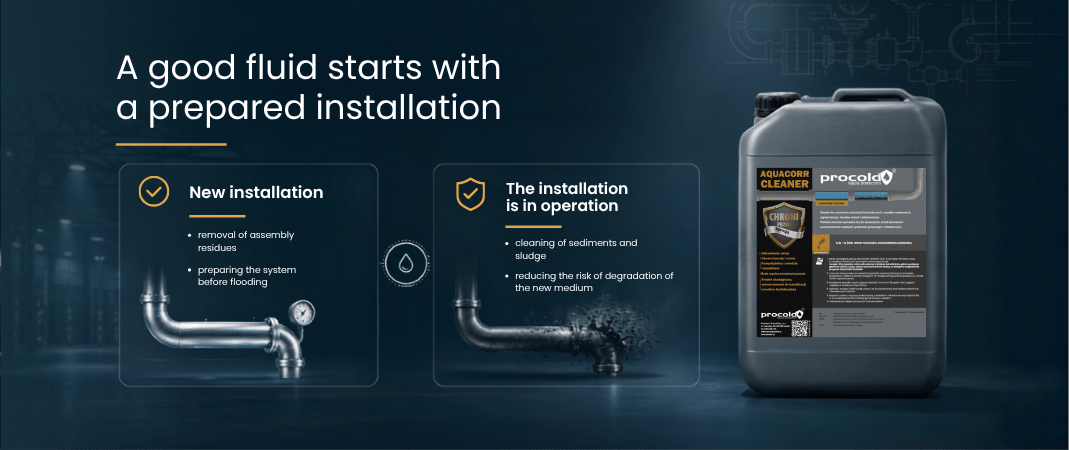
Flushing before filling helps remove substances that could contaminate the new fluid or interfere with its protective additives.
FACTORY FLUSH is intended for preparing glycol- and glycerine-based systems.
SUPERCOOL FLUSH is designed for systems intended to operate with potassium formate-based media.
Key benefit: the new heat transfer fluid enters a clean, compatible and properly prepared system.
Existing installation
An older system may contain:
- sludge and suspended solids,
- corrosion products,
- scale,
- biofilm,
- residues of the previous fluid,
- residues of previously used chemical products.
Before refilling, the type of contamination should be identified and an appropriate cleaning method selected.
AQUACORR CLEANER is a neutral cleaning product designed to remove sludge, metal oxides and corrosion deposits from hydraulic systems.
AQUACORR DESCALER is an acidic product used to remove scale, biofilm and deposits requiring descaling.
Key benefit: proper system preparation reduces the risk of premature degradation of the new fluid and helps restore suitable flow and heat transfer conditions.
More information is available in our article “How to Properly Prepare a System Before Filling It with New Antifreeze Fluid?”
6. Parameter monitoring and leak detection
Fluid selection does not end when the system is filled.
During operation, fluid parameters may change due to:
- high or low temperatures,
- dilution,
- system top-ups,
- oxygen exposure,
- corrosion,
- contamination,
- natural ageing.
It is therefore worth planning the monitoring method at the selection stage.
Freeze point and concentration monitoring
An optical refractometer can be used to check the freeze point and concentration of monoethylene glycol- and monopropylene glycol-based fluids.
Regular measurements help confirm that the fluid still provides the required level of protection.
Inhibitor monitoring
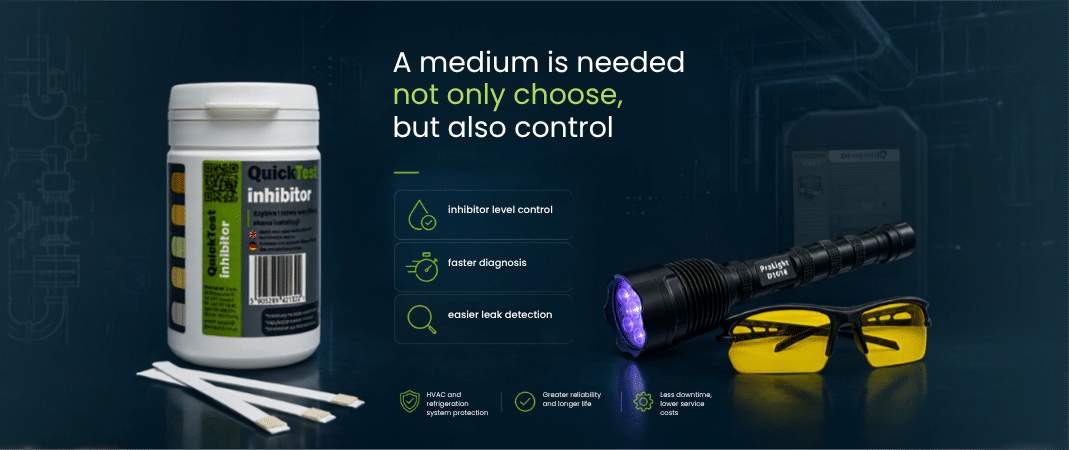
QUICKTEST INHIBITOR strips enable rapid verification of the inhibitor level in compatible AQUACORR OAT+ and AQUAPRO WOAT+ solutions.
The reading takes approximately one second, allowing basic checks to be included in routine servicing.
Leak detection
Selected Procold fluids feature a leak detection system compatible with the PROLIGHT D1018 UV lamp.
This can help:
- locate leaks more quickly,
- reduce diagnostic time,
- inspect difficult-to-access areas,
- limit the scope of work needed to identify the problem.
UV detection does not replace pressure testing, system pressure monitoring or standard service diagnostics. It is an additional tool that can make leak localisation faster and more precise.
Practical use of this method is described in the article “How to Detect a Leak in an HVAC System? PROLIGHT D1018 UV Detection Lamp in Practice.”
Laboratory testing
If the system shows reduced performance, deposits, colour changes, abnormal pH or suspected fluid degradation, a sample can be submitted for laboratory analysis.
Testing may include:
- freeze point,
- concentration,
- density,
- pH,
- alkalinity reserve,
- electrical conductivity,
- elemental composition,
- corrosivity,
- suspended solids,
- presence of microorganisms.
Key benefit: decisions about continued use, parameter correction, cleaning or fluid replacement can be based on test results rather than assumptions.
7. Fluid quality and origin
A heat transfer fluid may remain inside a system for many years. Its composition, origin and consistency of parameters should therefore be verifiable.
It is worth selecting products with:
- clear labelling,
- manufacturer details,
- batch number,
- current safety data sheet,
- technical documentation,
- clearly defined chemical base,
- verified parameters,
- required approvals.
Product traceability makes it easier to:
- select the correct fluid,
- monitor it later,
- diagnose problems,
- verify compatibility,
- plan servicing,
- assess its continued suitability.
Particular caution is advisable with regenerated fluids and products of unclear origin. In such cases, it may be more difficult to confirm the fluid history, composition, level of protective additives or possible residual contamination.
A lower purchase price does not always mean lower operating costs if the fluid parameters are unpredictable or difficult to verify.
Concentrates require proper preparation
A concentrate should be diluted in accordance with:
- the required freeze protection level,
- the mixing table,
- technical documentation,
- actual system operating conditions.
A higher concentration does not automatically mean better overall system protection. It also changes viscosity, density, thermal properties and pump requirements.
The best concentration is not the highest possible concentration, but the level correctly matched to the actual operating conditions.
Checklist before selecting a heat transfer fluid
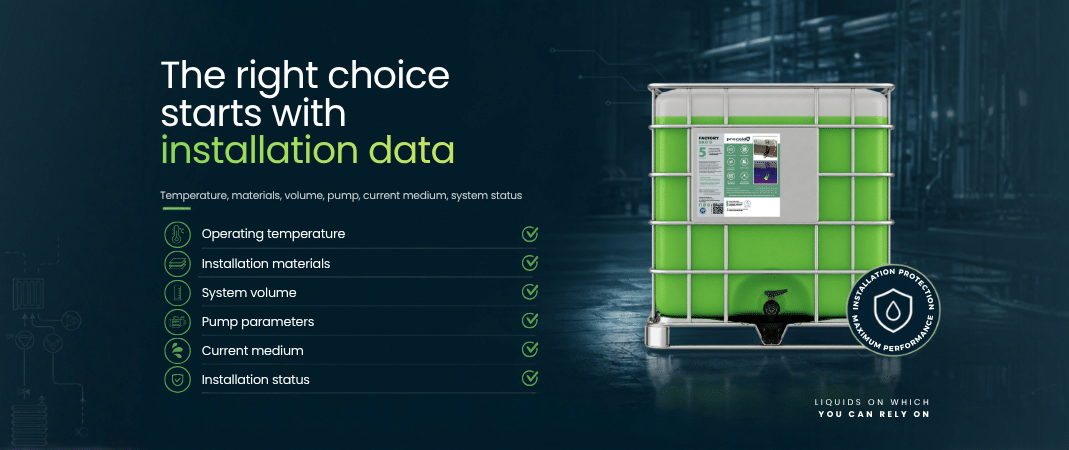
Before contacting the manufacturer, designer or supplier, prepare the following information:
- Type and purpose of the system.
- Minimum and maximum operating temperatures.
- Required freeze protection level.
- System volume.
- Required flow rate and pump parameters.
- Materials used for pipes, valves and heat exchangers.
- Types of seals and elastomers.
- Possibility of contact with people, water, food or the environment.
- Type of fluid currently present in the system.
- Technical condition of the system and history of previous problems.
- Planned method of fluid monitoring.
The more complete the data, the easier it is to select a solution that matches the entire system rather than only one parameter.
The right choice depends on the entire system
SUPERCOOL addresses the requirements of dedicated low-temperature systems.
FACTORY provides favourable operating parameters and economics in closed technical systems.
FACTORY EKO combines system protection with higher user-safety requirements.
FACTORY GLY uses the properties of glycerine in appropriately selected installations, including systems exposed to elevated temperatures.
GEOTHERMAL and GEOTHERMAL EKO are designed specifically for ground-source heat pump loops.
AQUAPRO addresses the requirements of water-based systems where freeze protection is not required but cleanliness and corrosion protection remain important.
Each solution has a different role.
The objective is not to identify one universally best product. It is to select the fluid whose properties best match the specific system.
Need help selecting the right heat transfer fluid?
Send us the basic information about your system:
- type and purpose of the installation,
- operating temperature range,
- system volume,
- required flow rate,
- pump parameters,
- materials and seals used,
- current fluid,
- technical condition of the system.
Based on this information, we can help identify the appropriate direction for fluid selection, system preparation and subsequent monitoring.
A well-performing system does not begin with choosing one “best” product. It begins with correctly understanding the operating conditions.
Frequently Asked Questions
What is the best heat transfer fluid for an HVAC system?
There is no single universal fluid. The correct choice depends on temperature, materials, safety requirements, pump parameters, system condition and operating conditions.
Can any glycol be used in a heat pump system?
No. The glycol type, required concentration, viscosity, inhibitor package, material compatibility and recommendations of the pump and component manufacturers should all be considered.
Does lower viscosity always mean a better fluid?
No. Lower viscosity can be beneficial under certain hydraulic conditions, but it does not determine whether the fluid is suitable for a particular system. Safety, temperature range, compatibility and system design are equally important.
Does a higher concentrate level provide better protection?
A higher concentration may lower the freeze point, but it also changes viscosity, density and thermal properties. The concentration should match the actual operating conditions.
Can new fluid be added to old fluid?
Not without confirming the composition and compatibility of both products. In many cases, the system should first be drained, cleaned and flushed.
How can the condition of a heat transfer fluid be monitored?
Basic monitoring may include freeze point, concentration, pH, density, electrical conductivity and inhibitor level. If irregularities are found, extended laboratory testing may be appropriate.
Does UV leak detection replace pressure testing?
No. UV detection makes it easier to locate the source of a leak, but it does not replace pressure testing, pressure measurement or standard service diagnostics.
Articles
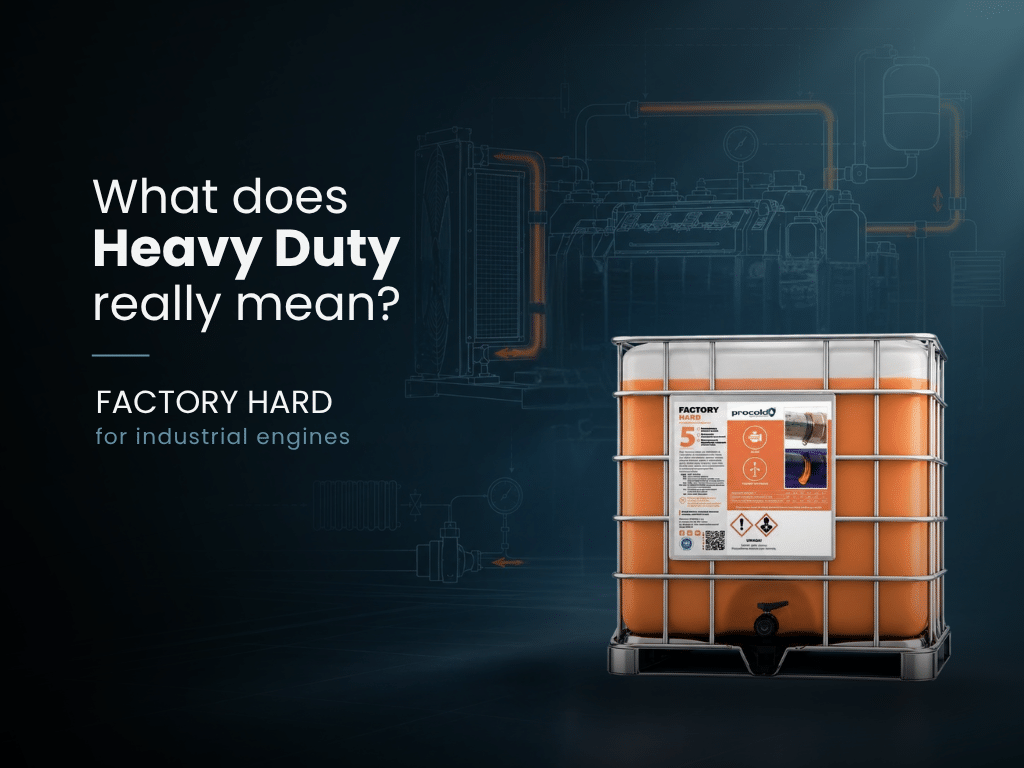
Heavy Duty Coolant for Industrial Engines – What Does It Really Mean?
How does a Heavy Duty coolant differ from a plain glycol base? We explain the role of inhibitors, […]
12/10/2026
How to Choose a Heat Transfer Fluid for an HVAC System? 7 Key Selection Criteria
Discover 7 key criteria: temperature, materials, safety, pump parameters and fluid monitoring.
24/09/2026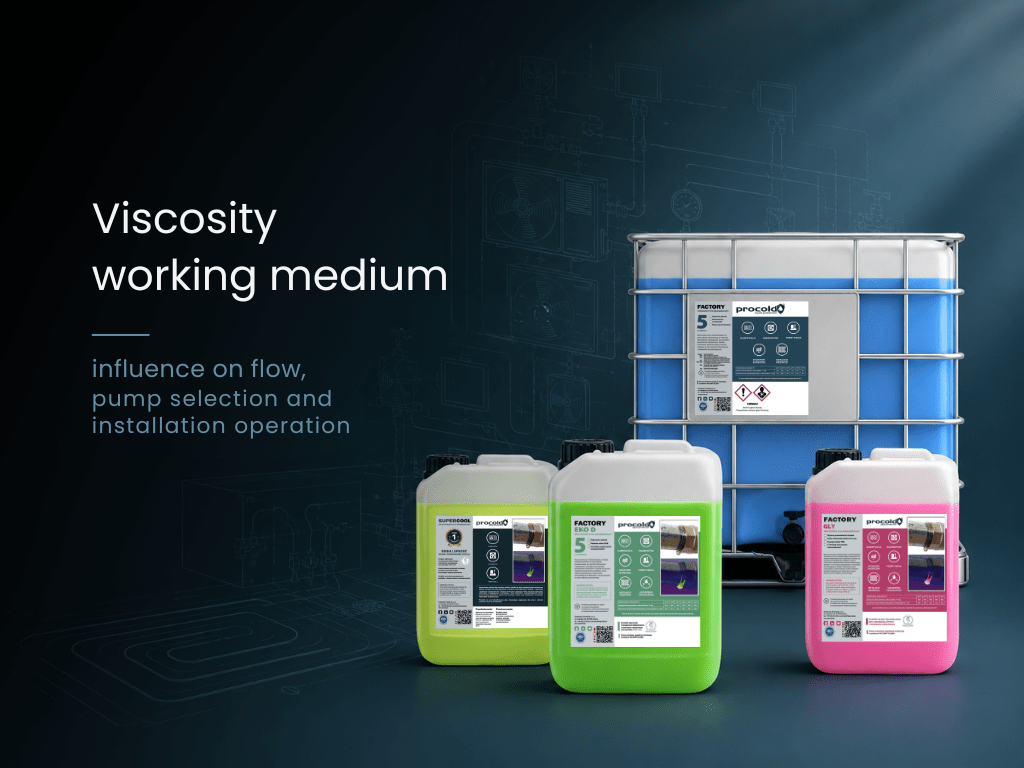
Heat-Transfer Fluid Viscosity in HVAC Systems: Why It Matters for Flow and Pump Selection
Learn how fluid viscosity affects flow, pump selection and HVAC system performance—and why every heat-transfer fluid requires the […]
05/08/2026
How to Detect Leaks in an HVAC System? The Prolight D1018 Detector Lamp in Practice
See how the Prolight D1018 helps you quickly detect leaks in HVAC systems.
02/07/2026
QuickTest Inhibitor – a quick check of the anti-corrosion protection of HVAC installations
See how QuickTest Inhibitor test strips help you quickly verify the level of corrosion protection in HVAC systems […]
01/06/2026
HVAC Optimization: How Aquacorr SI Restores System Efficiency (Case Study)
How can you protect your central heating and HVAC systems from corrosion? Discover an effective solution based on […]
28/04/2026
Water in a Heat Pump System – What Really Determines System Longevity?
HVAC system fluid – a key yet often overlooked factor in system longevity.
30/03/2026
Delivery of Factory ECO to a Large Installation – Behind the Logistics Process
What does the delivery of Factory ECO to a large installation look like? Discover the logistics process, loading […]
13/02/2026