



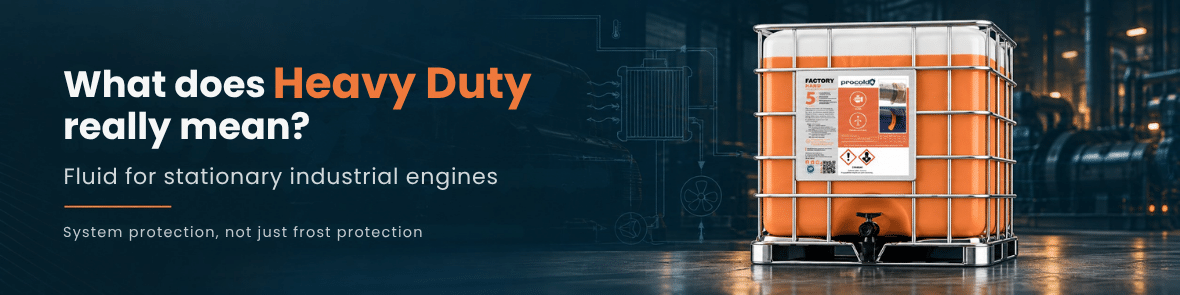


Heavy Duty Coolant for Industrial Engines – What Does It Really Mean?
The term Heavy Duty is often found on many coolants. In the case of stationary industrial engines, however, it does not simply refer to a glycol-based coolant or a product intended solely for protection against freezing.
In a demanding engine system, the fluid acts as a protective element for the entire system. It is not only the thermal properties that matter, but also the protection of system components against corrosion and cavitation, a suitably selected additive package, and the product’s compliance with the requirements of the specific application.
That is why, when choosing Heavy Duty fluid for industrial engines, the question ‘up to what temperature does it provide protection?’ is important, but it certainly should not be the only criterion.
How does a Heavy Duty coolant differ from a standard cooling medium?
The basic task of any cooling medium is to absorb and transport heat effectively. In stationary industrial engines, however, operating conditions are more demanding than in many standard systems.
The fluid operates in a system exposed to changes in temperature, flow and pressure, while remaining in contact with a variety of construction materials. Its role therefore goes far beyond providing a suitable freezing point.
In Heavy Duty applications, what counts is protection of the entire cooling system throughout its service life. This includes reducing the risk of corrosion and cavitation and maintaining the right properties of the fluid.
A good reference point is ASTM D6210 – the specification covering fully formulated glycol-based coolants intended for Heavy Duty engine cooling systems.
This means that “glycol” and “Heavy Duty coolant” are not synonyms.
Glycol can be the base of a product. A Heavy Duty coolant, on the other hand, is a complete medium developed to operate under specific service conditions.
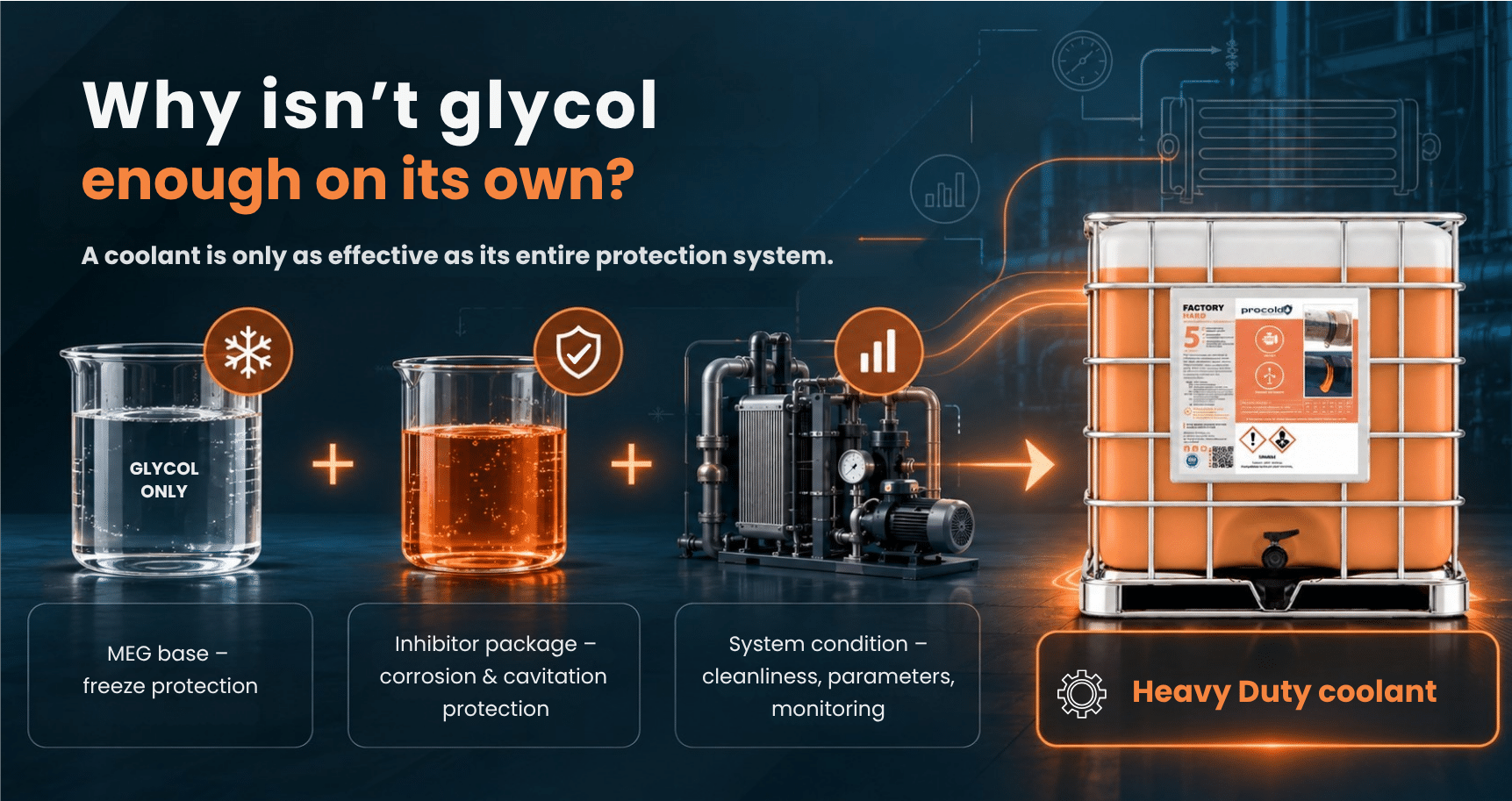
Why isn’t glycol alone enough?
Monoethylene glycol (MEG) can form the base of a specialised coolant and is responsible for a significant part of its temperature properties.
However, the type of glycol used does not tell the whole story about the finished product.
In fluids intended for demanding engine systems, the inhibitor package also plays a key role – its job is to support the protection of system components during operation.
FACTORY HARD is based on monoethylene glycol and a nitrite- and molybdate-based inhibitor package. The product is designed for the cooling systems of stationary industrial engines, and its declared properties include protection against corrosion and cavitation.
That is why two products based on the same glycol should not automatically be treated as equivalent solutions.
What matters is the medium as a whole: its intended use, protective technology, parameters and compliance with the requirements of the specific system.
Corrosion and cavitation – two different threats to the cooling system
The properties of a Heavy Duty coolant only become meaningful when we look at the real operating conditions of an engine.
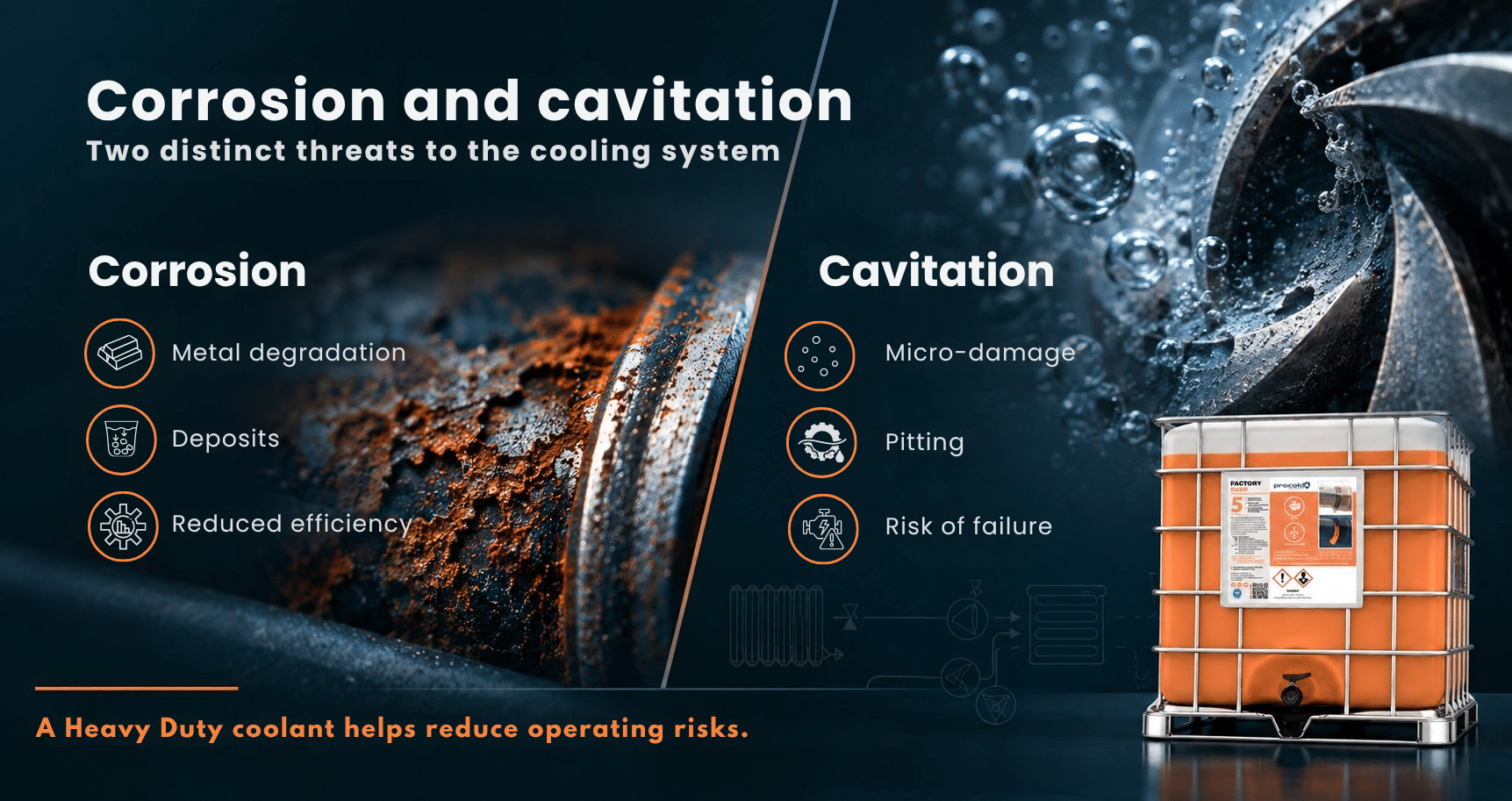
Two important phenomena that can affect the durability of a cooling system are corrosion and cavitation. They are different processes and should not be used interchangeably.
Corrosion in the cooling system
Corrosion can develop gradually and show no obvious external signs for a long time.
Conditions that favour it can be influenced by, among other things, the materials present in the system, temperature, the condition of the fluid, contamination and the way the system is operated.
Corrosion products can also enter the fluid, contribute to contamination and worsen the operating conditions of the system.
That is why anti-corrosion properties should be one of the key criteria when assessing a fluid used in industrial engine systems.
Cavitation in the cooling system
Cavitation is a different phenomenon.
Under certain conditions of local pressure changes in a liquid, vapour bubbles can form and then collapse violently. When this process repeats, it can act locally on metal surfaces and cause characteristic pitting.
This is exactly why anti-cavitation protection is an essential feature of the fluid category designed for demanding engine applications.
What role do inhibitors play in a Heavy Duty coolant?
In a specialised cooling medium, the glycol base is only one element of the whole product.
The second key area is the inhibitor system – the additives used to give the fluid specific protective properties.
FACTORY HARD contains an inhibitor package based on nitrites and molybdate. In this product, they serve to protect the system against the phenomena that occur while the engine is running.
This does not mean, however, that choosing a coolant comes down to comparing lists of additives.
What counts is how the medium performs as a whole and how well it matches the specific application.
So instead of asking only:
“What percentage of glycol does the product contain?”
it is worth asking a broader question:
“Is the medium as a whole suitable for the requirements of my cooling system?”
How should ASTM standards be understood for Heavy Duty coolants?
When comparing products for engine cooling systems, you may come across designations such as ASTM D6210, ASTM D4985 and ASTM D1384.
However, these designations should not all be treated as the same kind of information.
ASTM D6210 is one of the most important specifications covering the category of fully formulated glycol-based coolants for Heavy Duty engines.
ASTM D1384, on the other hand, is a laboratory test method used to assess how a coolant affects metal specimens under defined conditions.
This is an important distinction, because meeting the requirements of a given standard or test method should not automatically be equated with an individual approval from a specific engine manufacturer.
In practice, OEM documentation remains one of the primary sources of information when selecting a coolant.
FACTORY HARD – a Heavy Duty coolant for stationary industrial engines
FACTORY HARD is a specialised Heavy Duty antifreeze designed for the cooling systems of stationary industrial engines.
The product is based on monoethylene glycol and uses a nitrite- and molybdate-based inhibitor package.
Its declared properties include protection against corrosion and cavitation, as well as technology that makes leak detection easier. The product is also stated to comply with, among others, the requirements of ASTM D6210, ASTM D1384 and ASTM D4985.
Most important, however, is its intended use.
FACTORY HARD should not be seen merely as “glycol that protects against freezing”, but as a specialised medium for demanding industrial engine cooling systems.
What to look for when choosing a Heavy Duty coolant
The Heavy Duty label does not automatically mean that every product in this category is suitable for every engine.
Selection should start with the requirements of the specific unit and its operating conditions.
Before choosing or changing the coolant, it is worth checking:
- the engine manufacturer’s requirements – including the recommended coolant technology, required standards and any approvals;
- the system’s operating conditions – temperature, operating mode and type of load;
- the condition and cleanliness of the system – especially before switching to a different type of fluid;
- the type of fluid currently used and its top-up history;
- how the fluid will be monitored later on – its parameters, cleanliness and any losses.
When changing coolant technology, it is particularly important to check the condition of the system first. Replacing the fluid alone does not always solve the problem if the system contains contaminants, deposits or residues of the previously used product.
Heavy Duty starts with looking at the whole system
The key takeaway is simple:
a Heavy Duty coolant should not be judged solely by the type of glycol and its freezing point.
In stationary industrial engines, the equipment’s requirements, protection against corrosion and cavitation, the properties of the fluid used and the way the entire cooling system is operated all matter as well.
That is why a specialised medium should be treated as one element of a strategy for maintaining proper operating conditions in the system, rather than just a consumable that protects against frost.
FACTORY HARD was developed with exactly this application in mind – as a Heavy Duty coolant for the cooling systems of stationary industrial engines.
Need to select a coolant for a specific application?
Every cooling system operates under different conditions. If you are planning to replace the coolant, preparing a new installation or want to verify the technical requirements for a specific engine, get in touch with the Procold team.
Discover FACTORY HARD and check the product specifications → LINK
FAQ – Heavy Duty coolant for industrial engines
What does Heavy Duty mean for a coolant?
For industrial engines, the term Heavy Duty refers to a medium designed to operate in demanding cooling systems. What matters is not only temperature protection, but also suitable service properties and a system for protecting the components of the installation.
Are monoethylene glycol and a Heavy Duty coolant the same thing?
No. Monoethylene glycol can be the base of the product. A finished Heavy Duty coolant also contains a properly selected additive system and is developed for a specific application.
Is the freezing point enough to choose a coolant?
It should not be the only criterion. In an industrial engine system, you also need to consider the equipment manufacturer’s requirements, protection against corrosion and cavitation, the condition of the system and the operating conditions.
Does meeting an ASTM standard mean approval by the engine manufacturer?
Meeting ASTM requirements should not automatically be equated with an individual approval from a specific equipment manufacturer. When selecting a product, you should also check the OEM technical documentation.
Articles
Heavy Duty Coolant for Industrial Engines – What Does It Really Mean?
How does a Heavy Duty coolant differ from a plain glycol base? We explain the role of inhibitors, […]
12/10/2026
How to Choose a Heat Transfer Fluid for an HVAC System? 7 Key Selection Criteria
Discover 7 key criteria: temperature, materials, safety, pump parameters and fluid monitoring.
24/09/2026
Heat-Transfer Fluid Viscosity in HVAC Systems: Why It Matters for Flow and Pump Selection
Learn how fluid viscosity affects flow, pump selection and HVAC system performance—and why every heat-transfer fluid requires the […]
05/08/2026
How to Detect Leaks in an HVAC System? The Prolight D1018 Detector Lamp in Practice
See how the Prolight D1018 helps you quickly detect leaks in HVAC systems.
02/07/2026
QuickTest Inhibitor – a quick check of the anti-corrosion protection of HVAC installations
See how QuickTest Inhibitor test strips help you quickly verify the level of corrosion protection in HVAC systems […]
01/06/2026
HVAC Optimization: How Aquacorr SI Restores System Efficiency (Case Study)
How can you protect your central heating and HVAC systems from corrosion? Discover an effective solution based on […]
28/04/2026
Water in a Heat Pump System – What Really Determines System Longevity?
HVAC system fluid – a key yet often overlooked factor in system longevity.
30/03/2026
Delivery of Factory ECO to a Large Installation – Behind the Logistics Process
What does the delivery of Factory ECO to a large installation look like? Discover the logistics process, loading […]
13/02/2026