




Cavitation in Industrial Engine Cooling Systems – How It Develops and How to Reduce the Risk
Pitting on the outer surface of a cylinder liner, coolant loss with no visible leak, glycol in the oil analysis. In stationary industrial engines, these signs often share one cause: cavitation in the cooling system.
Cavitation develops on the hidden side of the liner, so it can go unnoticed for a long time. Its consequences, however, can end in liner replacement and unplanned downtime. We explain how cavitation develops, what increases the risk and what role the coolant plays. This article expands on a topic from our post Heavy Duty Coolant for Industrial Engines – What Does It Really Mean?.
What is cavitation in an industrial engine cooling system?
Cavitation in an engine cooling system is the formation and violent collapse of vapour bubbles in the coolant right next to a metal surface. The imploding bubbles strip away the protective layer, and when the inhibitors cannot rebuild it fast enough, localised corrosion sets in. The result is deep, localised pitting.
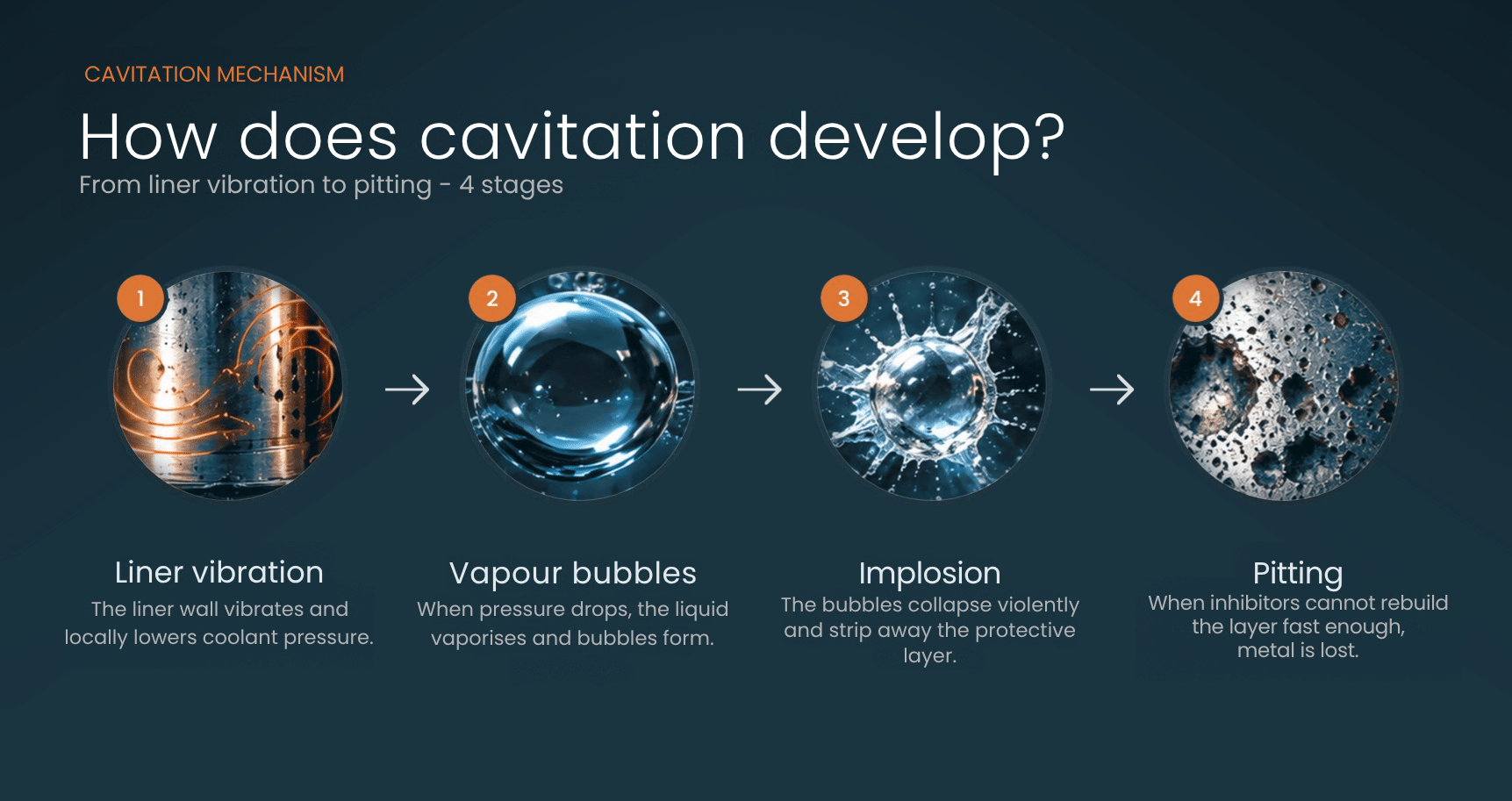
Cavitation therefore combines two processes: mechanical erosion and corrosion. In service practice, it is one of the main problems in industrial engine cooling systems – alongside corrosion, scale, contamination and microbial growth.
Where does cavitation occur? Liners, pumps and the engine block
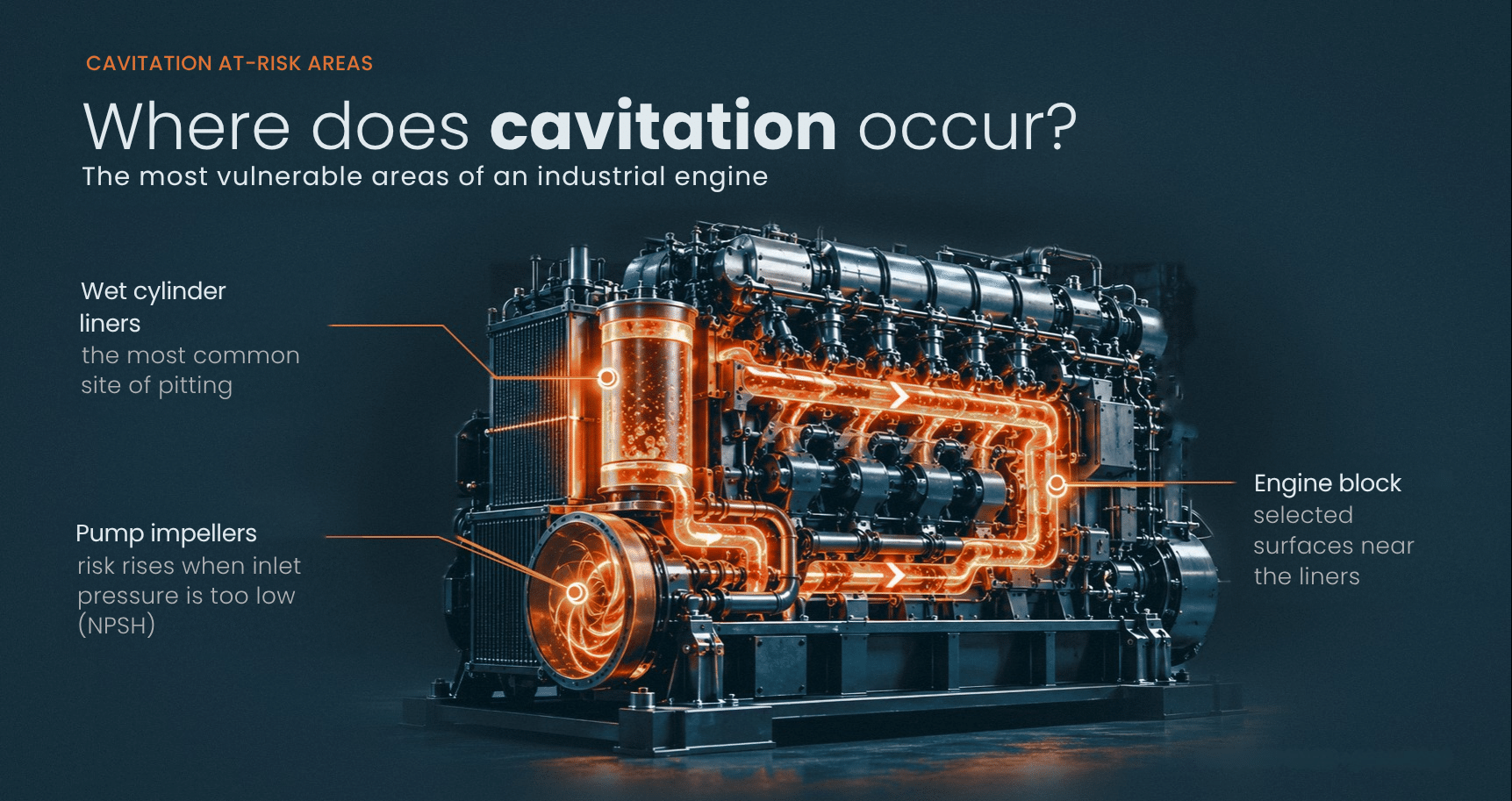
Three areas are most at risk:
- Wet cylinder liners. The liner is surrounded directly by coolant. As the piston works, the liner wall vibrates at high frequency. When the wall moves away from the liquid, the local pressure drops and bubbles form; they collapse as the wall moves back. Pitting usually appears perpendicular to the crankshaft axis.
- Coolant pump impellers. The risk increases when the required pressure at the pump inlet (NPSH) is not maintained.
- Selected surfaces of the engine block and crankcase near the liners.
In stationary engines that run thousands of hours a year under constant load, these micro-impacts repeat without a break. That is why cavitation protection is one of the defining features of Heavy Duty coolants.
Symptoms and consequences – how to recognise cavitation
Cavitation rarely shows clear external symptoms. The most common signs are:
- clusters of pits on the outer (coolant) side of the liner, visible only on disassembly – numerous and deep in severe cases,
- erosion of the pump impeller blades and noisier pump operation,
- damaged or hardened liner O-rings,
- coolant loss with no visible external leak,
- glycol or water in the oil analysis,
- rising iron content in the coolant analysis.
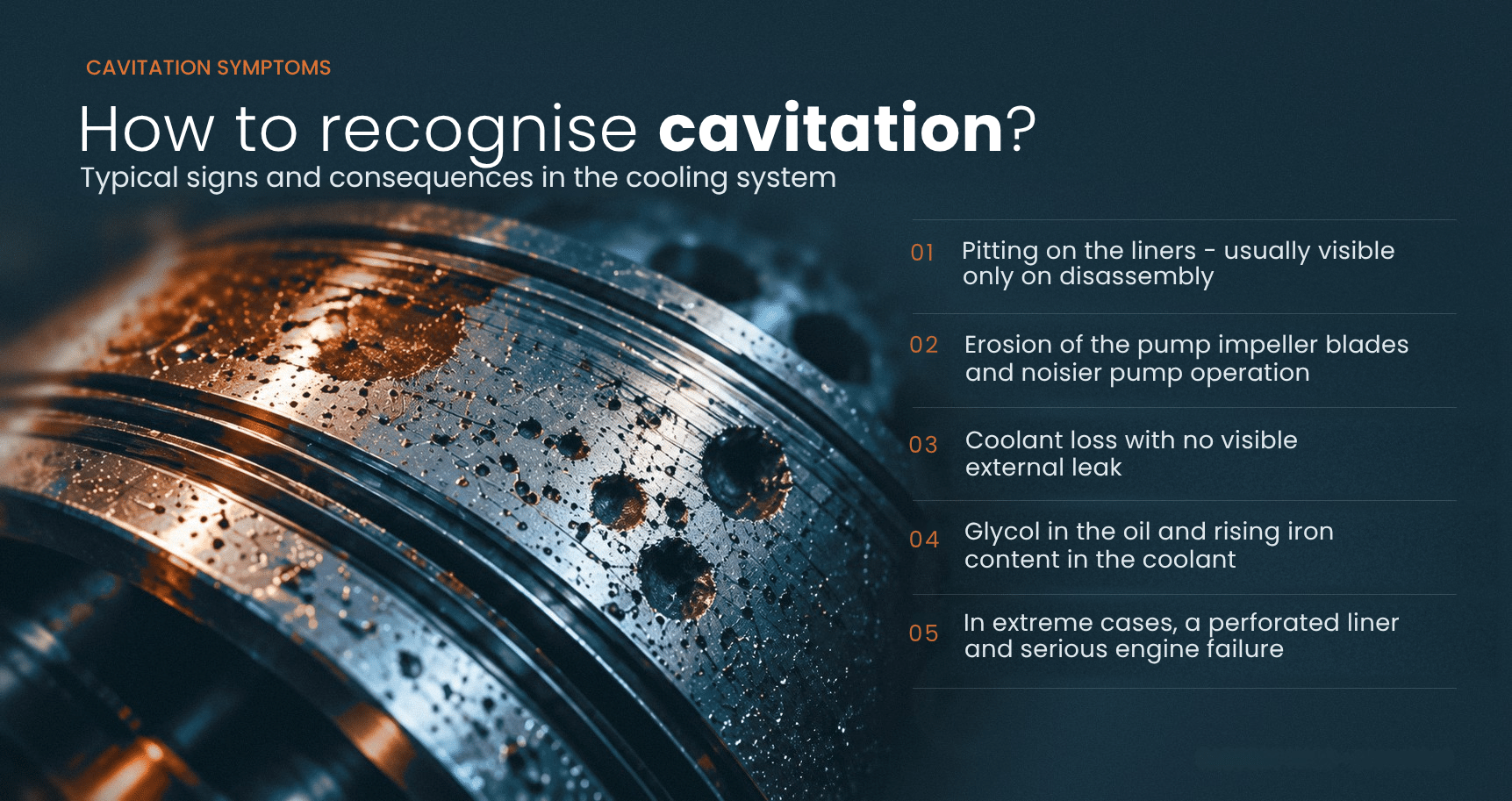
In extreme cases, a pit goes right through the liner wall. Coolant then gets into the oil or the combustion chamber, which means a serious failure. Because the first sign is often only an analysis result, regular oil and coolant analysis is the simplest way to detect the problem early.
What increases the risk of cavitation?
Cavitation depends on both the condition of the system and the condition of the coolant. The most common risk factors:
| Factor | Why it increases the risk | What to check |
|---|---|---|
| System pressure too low | Lower pressure makes it easier for vapour bubbles to form | The pressure cap and its rating as specified by the OEM |
| Air in the system | Trapped air promotes bubble formation and local overheating | Vent lines, expansion tank, filling procedure |
| Temperature close to boiling point | The liquid evaporates more easily when the pressure drops | Operating temperature, especially in systems with heat recovery |
| Pump inlet pressure too low | Promotes impeller cavitation | Compliance with the OEM requirements for the pump |
| Depleted inhibitor package | The protective layer is not rebuilt | Inhibitor level in the coolant analysis |
| Topping up with water or mixing coolants | Dilutes the protection and disrupts the coolant chemistry | Top-up history and glycol concentration |
The correct pressure cap rating and expansion tank capacity are specified by the engine manufacturer – they depend, among other things, on the jacket water operating temperature. The values in the manual for the specific engine always apply.
How does the coolant protect liners against cavitation?
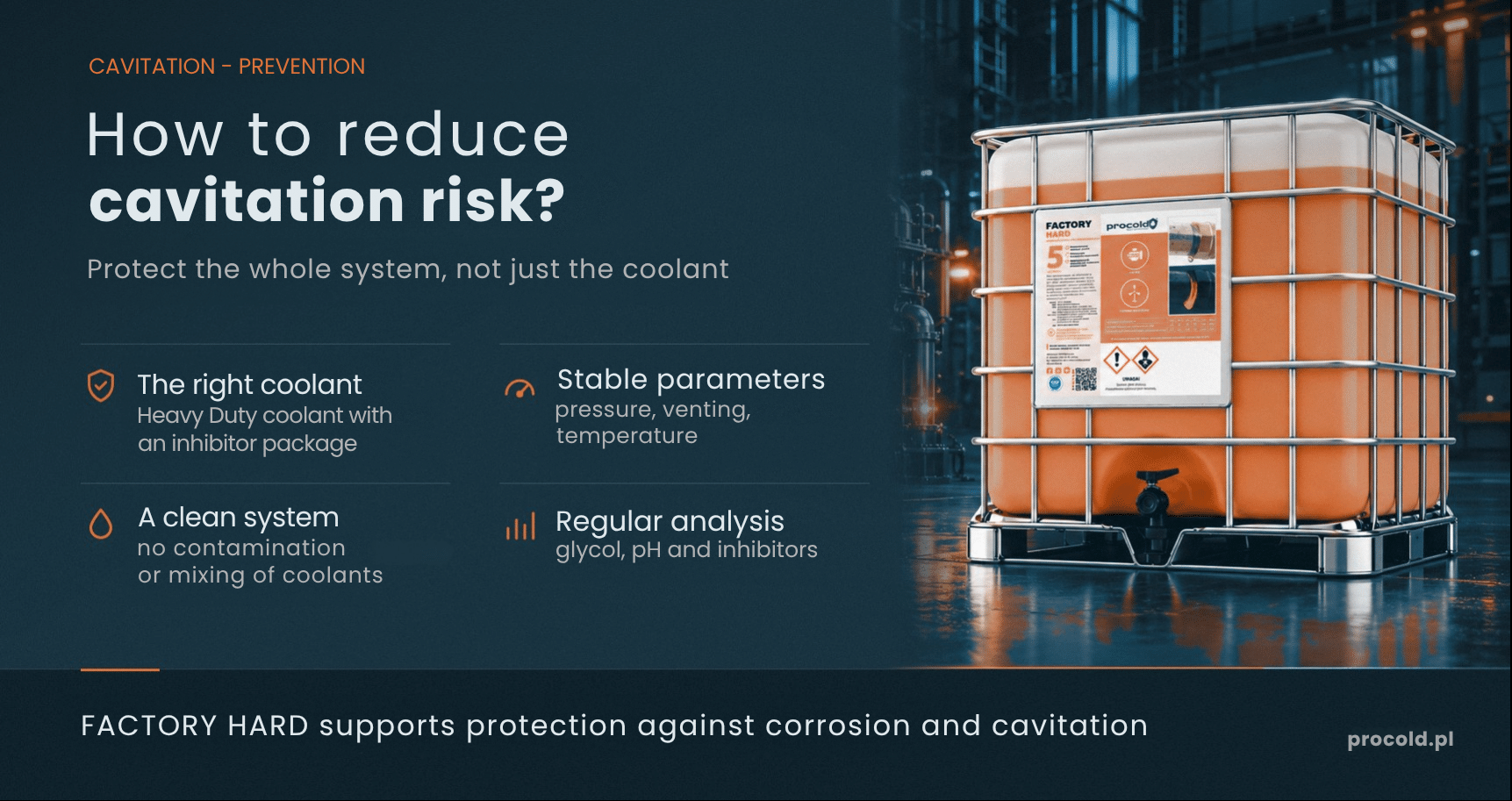
The coolant alone cannot prevent bubbles – they depend on vibration, pressure and temperature. Its job is to limit the damage: to rebuild the protective layer on the metal surface quickly, before localised corrosion can start.
Coolants for Heavy Duty engines use different protection technologies. Nitrite-based packages form a protective layer on iron and steel. Molybdate is a corrosion-protection additive that is often used together with nitrite. OAT coolants, in turn, rely on organic acids. The right technology is specified by the engine manufacturer – its manual is always the starting point.
It is also important that inhibitors are consumed during operation. Cavitation protection is therefore not a one-off fill, but monitoring of the coolant throughout its service life.
FACTORY HARD is a Heavy Duty antifreeze based on monoethylene glycol, designed for the cooling systems of stationary industrial engines. Its nitrite- and molybdate-based inhibitor package supports protection against corrosion and cavitation. The product meets ASTM D6210, whose scope includes protection against cavitation, and its detection technology makes leaks easier to find.
Cavitation in a routine inspection – what to check
During a cooling system inspection, go through these six points:
- Glycol concentration and coolant pH.
- Inhibitor level – in a periodic coolant analysis, as recommended by the coolant supplier.
- Oil analysis for glycol and water.
- Pressure cap function, system venting and the level in the expansion tank.
- Top-up history: how much was added and with what.
- On disassembly: the condition of the outer liner surface, the O-rings and the pump impeller.
Testing intervals are set by the engine manufacturer. Coolant is usually tested at regular intervals – measured in operating hours or months – and additionally after every major top-up. When changing coolant, do not mix different products – flush the system first, for example with Factory FLUSH.
Need to choose a coolant for an engine with wet liners?
Every cooling system works under different conditions. If your engine shows liner pitting or frequent coolant loss, or you are planning a coolant change, contact the Procold team. We will help you choose the right coolant and monitoring plan for your application.
Discover FACTORY HARD and check the product specifications →
FAQ – cavitation in engine cooling systems
Can cavitation be eliminated completely?
No. Bubbles form as a result of the vibration and pressure changes that come with engine operation. You can, however, significantly limit their effects: maintain the correct system pressure and venting, and use a coolant with a suitable, regularly monitored inhibitor package.
Does every glycol-based coolant protect against cavitation?
No. Glycol is mainly responsible for the temperature properties. Liner protection depends on the inhibitor package and its condition during operation. We explain this difference in more detail in our article on Heavy Duty coolants.
Can coolants of different technologies be mixed?
This is not recommended. Engine manufacturers strongly advise against mixing different coolant products. When changing coolant, the system must be completely flushed before refilling.
How often should coolant be tested?
As specified in the engine manufacturer’s manual. Coolant is usually tested at regular intervals, measured in operating hours or months. It is also worth checking it after every major top-up.
Sources
Articles
Cavitation in Industrial Engine Cooling Systems – How It Develops and How to Reduce the Risk
Pitting on cylinder liners is a typical result of cavitation. We explain where it comes from and what […]
23/11/2026
Heavy Duty Coolant for Industrial Engines – What Does It Really Mean?
How does a Heavy Duty coolant differ from a plain glycol base? We explain the role of inhibitors, […]
12/10/2026
How to Choose a Heat Transfer Fluid for an HVAC System? 7 Key Selection Criteria
Discover 7 key criteria: temperature, materials, safety, pump parameters and fluid monitoring.
24/09/2026
Heat-Transfer Fluid Viscosity in HVAC Systems: Why It Matters for Flow and Pump Selection
Learn how fluid viscosity affects flow, pump selection and HVAC system performance—and why every heat-transfer fluid requires the […]
05/08/2026
How to Detect Leaks in an HVAC System? The Prolight D1018 Detector Lamp in Practice
See how the Prolight D1018 helps you quickly detect leaks in HVAC systems.
02/07/2026
QuickTest Inhibitor – a quick check of the anti-corrosion protection of HVAC installations
See how QuickTest Inhibitor test strips help you quickly verify the level of corrosion protection in HVAC systems […]
01/06/2026
HVAC Optimization: How Aquacorr SI Restores System Efficiency (Case Study)
How can you protect your central heating and HVAC systems from corrosion? Discover an effective solution based on […]
28/04/2026
Water in a Heat Pump System – What Really Determines System Longevity?
HVAC system fluid – a key yet often overlooked factor in system longevity.
30/03/2026