





What are the most common problems with heat pump installation?
Heat pumps are regarded as maintenance-free devices. However, this does not mean that failure will never occur. For this reason, it is important to check the operation of the pump from time to time and to immediately react to any problems encountered. Heat pump malfunction can be the result of some kind of manufacturing defect or component failure, but also improper installation.

The most common mistakes made by installers
Many mistakes can be made during heat pump installation. Although professional companies usually have the right tools and procedures to minimise such risks, many less experienced service providers often lack them. What are the most common mistakes?
Failure to clean the system before priming
Before the system is primed with antifreeze, it must be thoroughly cleaned. It may happen that small filings and other impurities are left inside the pipes after installation. Such contamination poses a risk to the pump and may interfere with unobstructed flow of the fluid.
Thorough flushing of the system is mandatory after the heat pump installation, but some professionals skip this step in order to speed up the process. This is unacceptable and reflects the poor quality of the services.
Brittle lead-free solder joints
One of the most common causes of pump failure are brittle lead-free solder joints. The currently used solders have a lower resistance to damage, which can lead to a malfunction of the heat pump system. The system may become leaky and foreign bodies may enter it and damage the unit. In order to avoid such problems, it is essential to find an experienced installation team with the appropriate qualifications.

System bleeding
Filling the system with fluid also has to be done properly. If too little fluid is used, the efficiency of the system may be reduced, sometimes even causing failure alarms. Another problem can be air in the system. Improper bleeding may negatively affect the heat pump performance.
Correct operation
The user of the heat pump system should ensure that the unit is operating correctly. This applies in particular to pump errors and failures. If the pump starts up again following a failure, this does not mean that everything is fixed. Nor is it permissible to reset the controller by disconnecting the power supply for several seconds. Some models do not have an integrated memory and important information about the cause of the problems can be lost in this way. Whenever a major failure happens, it is always better to call a service technician to avoid its aggravation.
Full control
Although in Poland this solution is not yet popular, in the West heat pump systems are often equipped with sensors and measuring devices, which facilitate supervision of the proper operation of the system. Examples of sensors installed include:
- Temperature sensor of return water in the central heating system and working fluids in the pump systems.
- Pressure sensor of working fluid.
- Power meter for circulation pumps and heat pumps.
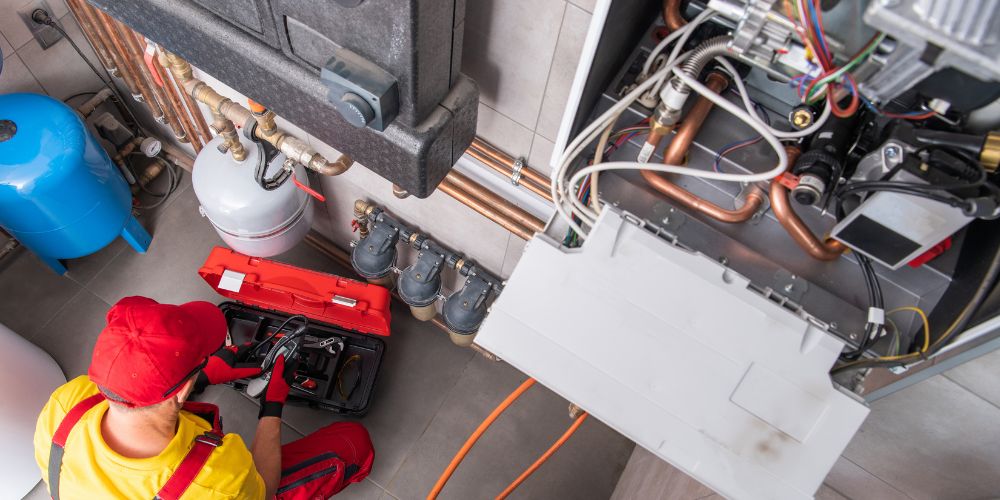
Sensors are most often installed on the pump, but the user does not always have access to accurate readings. It is also fairly easy to fit power meters on circulation pumps – it can be done with mobile plugin models, which do not require any interference with the electrical system. For the heat pump itself, a submeter is usually used.
An overview of all the relevant parameters allows to monitor the operation of the system and calculate how much electricity is consumed by its individual components. This way, it is possible to foresee potential problems, significantly reducing the costs of repair, as well as maintain high level of efficiency of the system.
Maintenance-free heat pumps and their supervision
Heat pumps do not require maintenance works during operation. However, the user is still obliged to supervise the correct operation of the system. No error or failure noticed should be ignored, as it may indicate the need for repair or potential error made by the installer. In either case, a service technician should be called to solve the problem.
Articles
Heat-Transfer Fluid Viscosity in HVAC Systems: Why It Matters for Flow and Pump Selection
Learn how fluid viscosity affects flow, pump selection and HVAC system performance—and why every heat-transfer fluid requires the […]
05/08/2026
How to Detect Leaks in an HVAC System? The Prolight D1018 Detector Lamp in Practice
See how the Prolight D1018 helps you quickly detect leaks in HVAC systems.
02/07/2026
QuickTest Inhibitor – a quick check of the anti-corrosion protection of HVAC installations
See how QuickTest Inhibitor test strips help you quickly verify the level of corrosion protection in HVAC systems […]
01/06/2026
HVAC Optimization: How Aquacorr SI Restores System Efficiency (Case Study)
How can you protect your central heating and HVAC systems from corrosion? Discover an effective solution based on […]
28/04/2026
Water in a Heat Pump System – What Really Determines System Longevity?
HVAC system fluid – a key yet often overlooked factor in system longevity.
30/03/2026
Delivery of Factory ECO to a Large Installation – Behind the Logistics Process
What does the delivery of Factory ECO to a large installation look like? Discover the logistics process, loading […]
13/02/2026
SUPERCOOL – a new era of efficiency in industrial refrigeratio
SUPERCOOL is a breakthrough in industrial refrigeration. Discover how potassium formate reduces energy costs and increases the efficiency […]
30/01/2026
Glycol or Water in Underfloor Heating with a Heat Pump?
Glycol in underfloor heating systems with heat pumps is now a safety standard. Find out why choosing the […]
29/12/2025