




Glycol or Water in Underfloor Heating with a Heat Pump?
Underfloor heating systems working with heat pumps operate under conditions that require high thermal stability, reliability, and resistance to unexpected situations. In such systems, the heat transfer fluid is not only responsible for transporting heat—it also plays a crucial protective role for the entire installation.
Although water is still used in some systems, installation practice and user experience clearly show that glycol-based solutions have become the standard in modern underfloor heating systems with heat pumps.
Water in Underfloor Heating Systems – Advantages and Disadvantages
Water has very good thermal properties and for many years was the basic heat transfer medium in heating installations. However, its use in heat pump systems requires ideal operating conditions.
✔ Advantages
-
High heat capacity – water transfers heat very efficiently, supporting system performance.
-
Low cost – inexpensive and easily available.
-
Low viscosity – lower flow resistance, allowing circulation pumps to operate with lower parameters.
✘ Disadvantages
-
Risk of freezing at 0°C. In the event of a heat pump failure, power outage, or prolonged building cooling, water can freeze and damage pipes and the heat exchanger.
-
No corrosion protection – untreated water may cause corrosion and scale formation.
-
Risk of air pockets and sediment buildup, reducing flow rates and system efficiency.
-
Requires ideal operating conditions – suitable only where the heat pump operates in an environment with no frost risk.
In practice, this means that installations located in garages, technical rooms, intermittently used buildings, or systems exposed to power interruptions are particularly vulnerable when water is used as the heat transfer fluid.
Alternative Recommendation: AquaproVDI 2035
If the user decides not to use glycol, Procold recommends replacing standard water with:
AQUAPROVDI 2035 – boiler water with corrosion inhibitors
Why choose it?
-
Provides full corrosion protection for the installation.
-
Is chemically stable and does not form deposits.
-
Suitable for indoor installations where there is no risk of freezing.
Important
AQUAPROVDI 2035 does not protect against freezing, therefore it should not be used in installations exposed to temperatures below 0°C, such as:
-
heating nodes in garages,
-
unheated boiler rooms,
-
heat pumps installed outdoors.
Glycol in Underfloor Heating Systems – Advantages and Disadvantages
In underfloor heating systems working with heat pumps—especially those exposed to variable temperatures—glycol solutions provide effective protection for the entire system.
✔ Advantages
-
Freeze protection – glycol solutions protect installations down to –30°C or lower, depending on concentration.
-
System protection – corrosion inhibitors and anti-foaming additives protect copper, steel, aluminum, and plastics.
-
Safety in case of failure – glycol remains fluid, ensuring minimal circulation even at low temperatures.
-
Long-term stability – glycol-based fluids do not form deposits or scale.
✘ Disadvantages
-
Higher viscosity than water – circulation pumps may operate under slightly higher load.
-
Higher initial cost than water, although the risk of costly failures usually far outweighs the price difference.
-
Requires correct concentration selection – too low does not protect against frost, too high reduces system efficiency.
In practice, properly selected glycol significantly reduces the risk of failures, which in heat pump systems can result in very high repair costs.
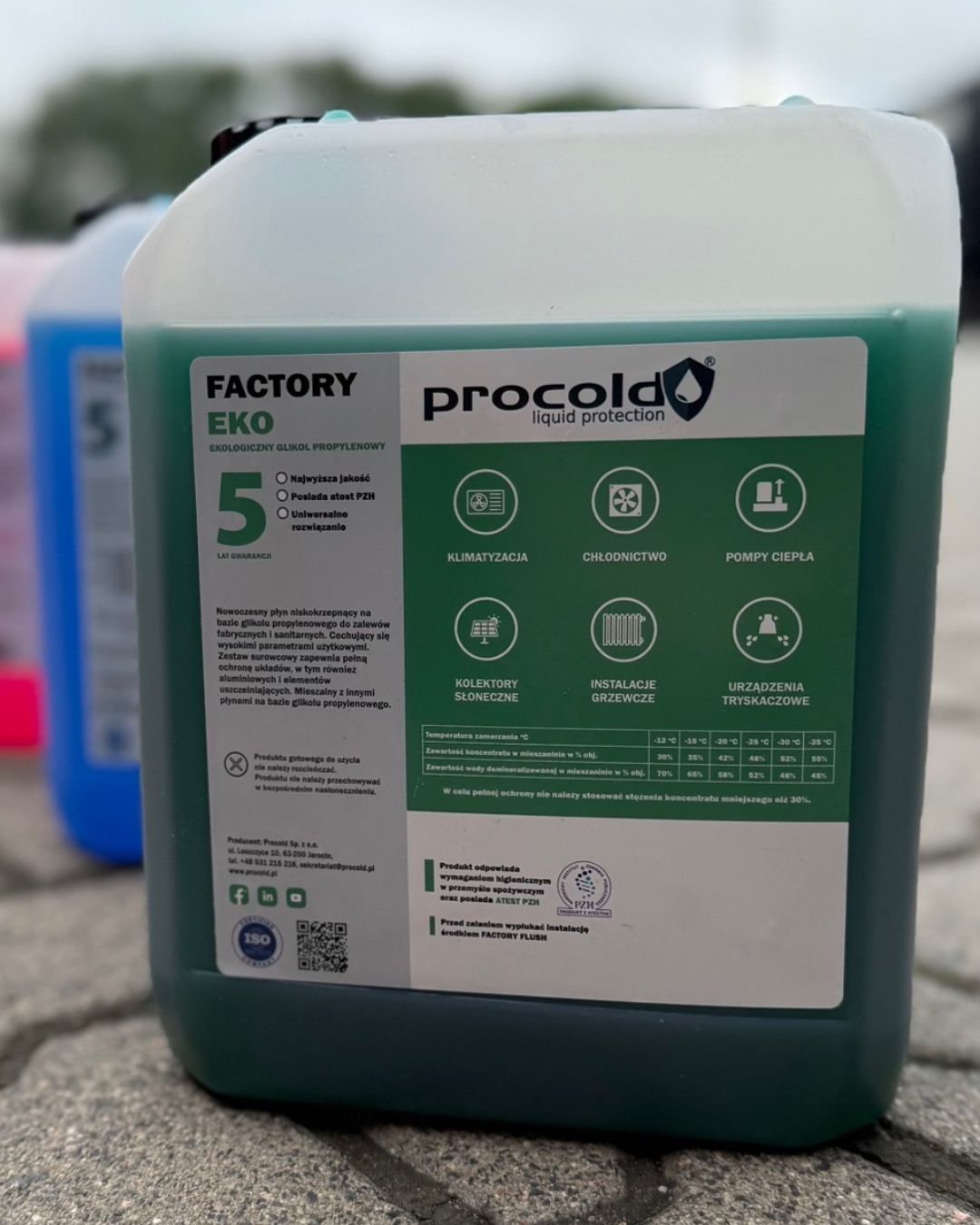
Why Choose Factory EKO?
Factory EKO is a line of professional antifreeze fluids developed specifically for HVAC systems, heat pumps, and underfloor heating installations.
They are distinguished by:
-
High-quality monopropylene glycol (MPG) – safe, non-toxic, and environmentally compliant.
-
Advanced corrosion inhibitors – long-term system protection and minimized risk of deposits.
-
Full compatibility with heat pumps and underfloor heating flow meters, ensuring stable flow parameters.
-
Precise glycol concentration adjustment to match operating conditions.
-
Factory-controlled quality and repeatability, eliminating the risk of contamination.
Glycol as an Investment in System Durability
Using a properly selected glycol:
-
extends the service life of the installation,
-
stabilizes heat pump operation,
-
minimizes the risk of failures,
-
provides peace of mind regardless of external conditions.
That is why in modern underfloor heating systems glycol is not an optional add-on—it is a key element of a professional system design.
Summary
Although water still has applications in strictly defined conditions, high-quality glycol—such as Factory EKO—is currently the most universal and safest heat transfer fluid for underfloor heating systems with heat pumps.
It is a solution that:
-
protects the installation against freezing,
-
prevents corrosion,
-
ensures stable and trouble-free operation for many years.
Articles
Glycol or Water in Underfloor Heating with a Heat Pump?
Glycol in underfloor heating systems with heat pumps is now a safety standard. Find out why choosing the […]
29/12/2025
5 signs that the antifreeze in your system needs urgent replacement – a practical guide for installers and industry
Antifreeze fluids — propylene glycol, ethylene glycol, brines or potassium formate solutions — play a key role in […]
10/12/2025
A stress-free September? How PROCOLD helps prepare your installation for the cooling season – from canisters to tankers!
Early September. The sun is still warm, but there is already a hint of autumn in the air. […]
29/11/2025
Glycol versus Supercool – which cools your system better?
Choosing the right antifreeze for your system is crucial for its efficiency, reliability, and longevity. We often colloquially […]
17/10/2025
How to properly prepare the system before filling it with new antifreeze? The role of flushing agents, inhibitors, and diagnostics
In the HVAC industry, there is increasing talk about a responsible approach to the operation of heating, cooling, […]
09/10/2025
Impact of antifreeze quality on HVAC systems
Antifreeze fluids play a key role in HVAC systems. They are not only a medium that transports heat […]
29/11/2024
Modern flushing and filling station – your partner in keeping your installation in perfect condition
Nowadays, the efficiency and reliability of heating, cooling and HVAC systems are crucial for both residential and industrial […]
15/11/2024
What are the prospects for the development of antifreeze fluids in the context of increasing energy requirements?
In the face of global change and increasing energy demands, the refrigeration and heating industry is facing new […]
23/08/2024